He gives waiting a new name,
letters cracked before some waltz
between the inky wisps of
offspring’s breathless consummations.
She’d say the man came from the sea,
deliberate flesh sweeping the dawn.
Mermaid’s tears they say save drowning men;
experts at watermarks on--
wait--paper from the trees that sip on mystery
and useless homage. A communion
by breeze, passing by like
forfeit of worry in the storm.
He gives waiting a new name: outside,
what hopeful knowing shakes for that flesh,
his flesh, and three ripe bruises. Waits--
for the letters of my name, land-locked,
and searching for the sea.
Like faith, I am everywhere and always
different: I could live in any house, sigh
my pages over many shores. I could
give waiting a new name.
My sea secrets inhabit more my ancestry, anatomy,
I am precise, and fineness form.
Forgotten is a long, long time, and
when you think about it,
the things you crave--wait--gasp
and swallow everything
to recreate the world.
She’d say--I came from the sea--
as if leaving open shelves could heave
her stories into waiting caves.
Friday, 14 December 2012


Wednesday, 5 December 2012
Weekly Wisdom From Mr. Trollope
"The secrets of the world are very marvellous but they are not themselves half so wonderful as the way in which they become known to the world."
The Once and Future Queen
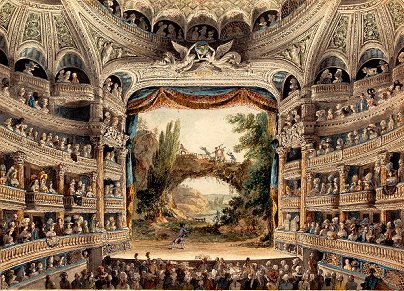
It occurred to me as I watched the Stoppard adaptation, which places the story and its characters within the context of a theatre, how much Anna is like an actor, with her ever suggestible mind. Her present life is static; it has little movement. But then she boards a train, and travels to Moscow, where the vision of a man suggests to her--perhaps memories she used to have, perhaps ideas for what the future could hold--and she creates a new and vibrant present. This creation is what happens in the theatre, where past and future combine to make a present--a heightened present, a dramatic present. A constructed present.
There are some stories that take on a life larger than their own--like the tales of King Arthur and his knights of the Round Table--that confuse history and allegory, fact and myth--a world created for the world at large. Anna Karenina is such a story: an expansive tale, far flung and far reaching. I was so pleased that this latest cinematic treatment used a theatrical framework to encompass the tale's scope. That the narrative is placed inside a jewel-box of a Victorian theatre reminds us that this is a story; this is an imagined world that must be contained, whether between two covers, a proscenium, or a screen--or, indeed, the mind of our heroine. And the limitation enhances its universality; theatres are small but they hold a world. Because it is small, its reach can be wide. It is such a beautiful way to take these characters off their pages, and breathe them into a place where we re-imagine humanity. To see it on the screen even more lovely--the medium of film bows to the living nature of theatre. Frames within frames, as Pirandellian as it gets, a trinity of limitless time. There are so many ways to open a story, so many ways to re-tell them. It is this cyclical drama that compels me at the moment, as I prepare to return to a world I visited once before, to get to know a character I met for a time, re-discover the woman I was with her then and discover the woman I can be with her now
I begin to remember that land like watermarks on my skin, or in a gesture, a turn of phrase, and then I begin to re-imagine it on different soil, suggest to myself the possibilities. It was once and will be again, and that is how I'll presently find myself on a plane to Camelot. Camelot! I hear there's not a more congenial spot . . . .
Tuesday, 13 November 2012
Weekly Wisdom from Mr. Trollope
"Perhaps no terms have been so injurious to the profession of the novelist as those two words, hero and heroine."
Negative Capability
 I've been taking language classes in the city with some consistency--I began Italian, I continued French. The most recent return to French has been a grave disappointment; in having to learn the rules of things I knew instinctively--having learned the language as an eight year old--I found a new definition of knowing and a dissatisfaction with structured learning. I knew certain lessons without understanding the rules; in trying to learn the rules, I lost the lesson. Things I knew were no longer clear, and yet what I had known was not based in anything I could define.
 When I decided to finally bite the bullet, and sign up for a poetry workshop, I smiled reflectively--perhaps I had been studying language when all I really wanted to do was speak. As I read through past entries on this blog, specifically those for several months of 2009, I am reminded of a discovery; of learning to live with mystery. An idea articulated to me at the time by Keats. Like language, I suppose, that which we learn to live with can become unlearned with living, and so I think I as I struggled to understand the rules, to read the signs, I returned to the idea of poetry as a means to soothe my attempts at rigidity.
Upon returning home from a rather poetic journey to Edinburgh to visit family I had spent years imagining, or dreaming about--there is no greater ordered mystery than what your mind designs when it is at rest--I found waiting for me in my inbox readings for the workshop I'd signed up for. There he was again, Keats waving to me from beyond, emboldening my soul to accept mystery--to be "capable of being in uncertainties, mysteries, doubts, without any irritable reaching after fact and reason." Suddenly, the title of the class became clear: "Shadows and Mayhem." It means nothing and everything--it seeks. There is also an essay from Fanny Howe called "Bewilderment"which describes poetry as a way to "resolve the unresolvable."
Randomness, uncertainty, bewilderment: this is how the middle of my day looks. Sometimes, in the morning, I awake with surprise to find myself alone ( I am sure my dreams are populated). Sometimes, at evening, I refute mystery with searing diligence (I will not look anywhere I can't see). "For myself," writes Howe, "a poem emerges by itself, like something developing in a dark place. First I see the impression of a time period as an experience of pure language, glimpses of actions, emotions and weathers. I jot down whatever comes through--in a rush of words. Then I begin to see what is being said and to see it as it unfolds . . . ." And there, I suppose, is the clarity in bewilderment, the raising of the eye curtain, the serendipity of a chance meeting, the supreme engineering of a bridge: strength, structure, grace, and beauty; male and female, support and passage; a constant communication of wires and stone, a balancing act of math and mystery.
Tuesday, 23 October 2012
Weekly Wisdom from Mr. Trollope
The fault which people find with him is this, that he is not practical. He won't take the world as he finds it. If he can mend it, well and good; we all ought to do something to mend it; but while we are mending it we must live in it.
Sunday, 14 October 2012
Weekly Wisdom from Mr. Trollope
She had learned, or thought that she had learned, that most girls are vapid, silly, and useless - given chiefly to pleasure-seeking and a hankering after lovers; and she had resolved that she would not be such a one.
will-o'-the-wisp

I'd really like to be more consistent in my blogging/grieving than I have been of late--looking back at my earliest posts, I'm pleased with my output. I wrote consistently, weekly. As I began to work more frequently, I wrote less, but this blog served as guidepost, marker for the work I was doing--from expectation (when my eyes start to recognize the world around me in light of the play I'm about to begin) to post-mortem (when my eyes start to adjust to how the play has helped me see the world). My last entry was written in the cross hairs of these markers--as one play was ending, and another already beginning rehearsals. And I ended the entry with a thought, a thought towards travel, and a desire to see the ocean--and I kept my word: as I started to write this, I was miles high, flying across the country to the west coast to visit the sea. There was an effectiveness to having written this wish down-- an incentive toward accomplishment. The play closed a week ago, and I'm celebrating it with a trip to see its main character, that "old devil sea," and while I feel like the play is already very far away, I see it all around me--especially mermaids on ladies' room doors (funny, actually, how many mermaids you find in how many bathrooms when you start to look for them). As I go about my life, I am surprised to look down at my wrist and see the remnants of accidental scratches made there by another actor, by a character.
There's poetry in this--wisps of art and life intertwined. Poetry: two years ago I was writing poems for the first time, and posting some of them here. As I was performing Anna Christie, I started to feel the urge to try again, only this time it didn't come as readily as it did before. I tried over and over, wrote and re-wrote. And I'm still writing, but taking it slow this time (as my father, the real poet, advised). In the meantime, I have been eyeing creative writing workshops in the same way I often scroll through the pages of anthropologie.com. I wish I'd been in the poetry workshop this summer; I wish I wrote fiction and might be a candidate for their fall writing course, "Writing about Animals"--they get to take trips to the Bronx Zoo! I'd like to think that if I was writing fiction, it would have animals in it. Animals as metaphors are nothing new to literature, or to my mind; as a child actor, I used to instinctively refer to my feelings about and memories involving animals to stand in for things--feelings, situations--I had not yet experienced for or with humans. It is no wonder that animals are so prevalent in children's literature--they give us "love without speech," as Elizabeth Barrett Browning wrote, when we are just starting to learn to speak this language. Animals are good to work with; they require our imagination. So like poetry, fiction, and drama, animals, too are our creations--a kind of knowing unknown, a kind of a sea--just like the ocean, and the theatre, and these characters we leave behind, these wisps of artistry and humanity, and these fading scars on a wrist that belonged to another me.

Monday, 18 June 2012
A Kind of Sea

Tuesday, 1 May 2012
It was the best of times, it was the worst of times
 |
| Shaw |
"Young men are pretty much the same everywhere, I guess. They never have their wits about them. They never mean what they say, because they don't understand the use of words. They are generally half impudent and half timid ... Indeed there is no such thing as a young man, for a man is not really a man till he is middle-aged. "
Monday, 26 September 2011
Weekly Wisdom from Mr. Trollope
I have lived with my characters, and thence has come whatever success I have attained.
Re-Visioning Jane

Subscribe to:
Posts (Atom)